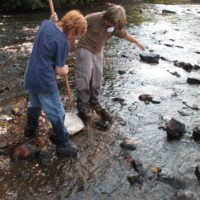
This course looks at stream ecology through the lives of stream invertebrates and macroinvertebrates, large organisms (macro) enough to be seen with the naked eye and lack a backbone (invertebrate). They inhabit all types of running waters, from fast-flowing mountain streams to slow-moving muddy rivers. Examples of aquatic macroinvertebrates include insects in their adult, larval, or nymph forms, mollusks, crustaceans, and worms.
We will learn about their life histories, ecological interactions, and benefits to people, explore how they relate to their surrounding riparian and watershed environments, and how both are affected by people. In addition to the lecture, the class will include hands-on labs with live specimens and learning to use the website macroinvertebrates.org to see them up close, to both learn to identify them, and to learn about how they deal with environmental stress.
NOTE: Late summer and fall, NHSM hosts Go With the Flow Community Stream Days at Leakin Park, where you can put your new skills to practical use collecting andidentifying stream invertebrates. More info here: https://marylandnature.wildapricot.org/event-6606820
Dr. Ken Belt has studied urban streams and their ecology in Baltimore for 40 years. He has worked for the Baltimore City Department of Public Works, the USDA Forest Service, and the Baltimore Ecosystem Study, and now teaches at the Department of Geography and Environmental Science at UMBC. His perspective has been holistic, with an eye for both the engineering of the urban landscape and the connections to aquatic ecosystems. He is also a new curator for NHSM, where he is starting an aquatic insect collection and planning various identification training and education venues. Ken’s research interests focus on the interactions between stream biogeochemistry and ecological structure and function, and how these are affected by the mosaic of forests and engineered infrastructure on and within urban landscapes. Currently, he is encouraging the use of ecohydrological principles in the design of stormwater management networks, in particular those using a Nature-Based Solutions approach.
NEW Payment and Cancellation Policy: Payment is due online at the time of registration. Cancellations made 14 or more days in advance of the event will receive a refund minus a 5% processing fee. Cancellations made within 14 days of the event will not receive a refund. Events and field trips with fees of $25 or less are non-refundable at any time unless canceled by NHSM. NHSM retains the right to update or change these requirements at any time.